



Lash Lift Processing & Timing
Lash Lift Processing & Timing
Timing Is a Guide, Not a Rule
Processing time is the part of a lash lift that catches people out, because it is not a fixed number. The guideline timings tell you roughly how long each step needs, but the real skill is learning to recognise a fully processed lash. Leave the products on too briefly and the lift is underwhelming and drops early; leave them too long and the lashes become fragile and can break. The figures below are guideline timings for the cysteamine system, which processes more slowly and more gently than a traditional TGA lift — a TGA-based solution works faster and has its own, shorter timings. Either way, the times are a starting point, adjusted on the day to the lashes in front of you.
Guideline Processing Times
Lash density sets the baseline: finer lashes process faster, thicker lashes need longer. The lifting cream (Step 1) takes the most time; the neutraliser (Step 2) is shorter. When the lifting powder is mixed in to thicken the formula, the times shift slightly longer, shown in the dedicated columns.
| Lash type | Step 1 | Step 1 + Powder | Step 2 | Step 2 + Powder |
|---|---|---|---|---|
| Fine lashes | 7–10 min | 8–12 min | 5 min | 5–7 min |
| Natural lashes | 10–12 min | 11–13 min | 6 min | 6–8 min |
| Thick lashes | 12–15 min | 13–17 min | 7–10 min | 8–11 min |
Start the timer before applying the product, not after, and treat the densest areas — usually the roots — first, since they take longer to relax than the finer tips. These timings belong to the cysteamine system; a TGA lift will reach the same point sooner. The steps themselves are explained in the three-step lift system.
What Changes the Timing
Density is only the starting point. Four other things move the clock, and reading them is what turns a guideline into the right time for a given client.
- Formula. Cysteamine-based lifts process more slowly than TGA. The two are not left on for the same length of time, which is the core of the TGA vs cysteamine comparison.
- Room temperature. A cold room slows processing; a warm room speeds it up. The same lashes can need noticeably different times in winter and summer.
- Powder. The more lifting powder is mixed in, the slower the process. Too much thickens the formula past the point of working efficiently.
- Balm. Lifting balm slows processing too, so the hair needs checking at regular intervals when it is used.
How powder and balm change the formula's behaviour is covered in lash lift balm, cream or powder.
Reading a Processed Lash
Because no two sets of lashes process identically, the timer is a prompt to check rather than a finish line. The check is a "lash check": work a micro applicator lightly through the lashes to test how pliable they are. A relaxed lash bends and moves with the tool; a lash that still resists needs longer. Treat the denser areas first and judge relaxation while keeping the lash healthy — the aim is a fully relaxed lash, not the longest possible time on the clock. Under-processing leaves a weak, short-lived curl; over-processing leaves brittle lashes that can break, which is one of the most common lash lift mistakes.
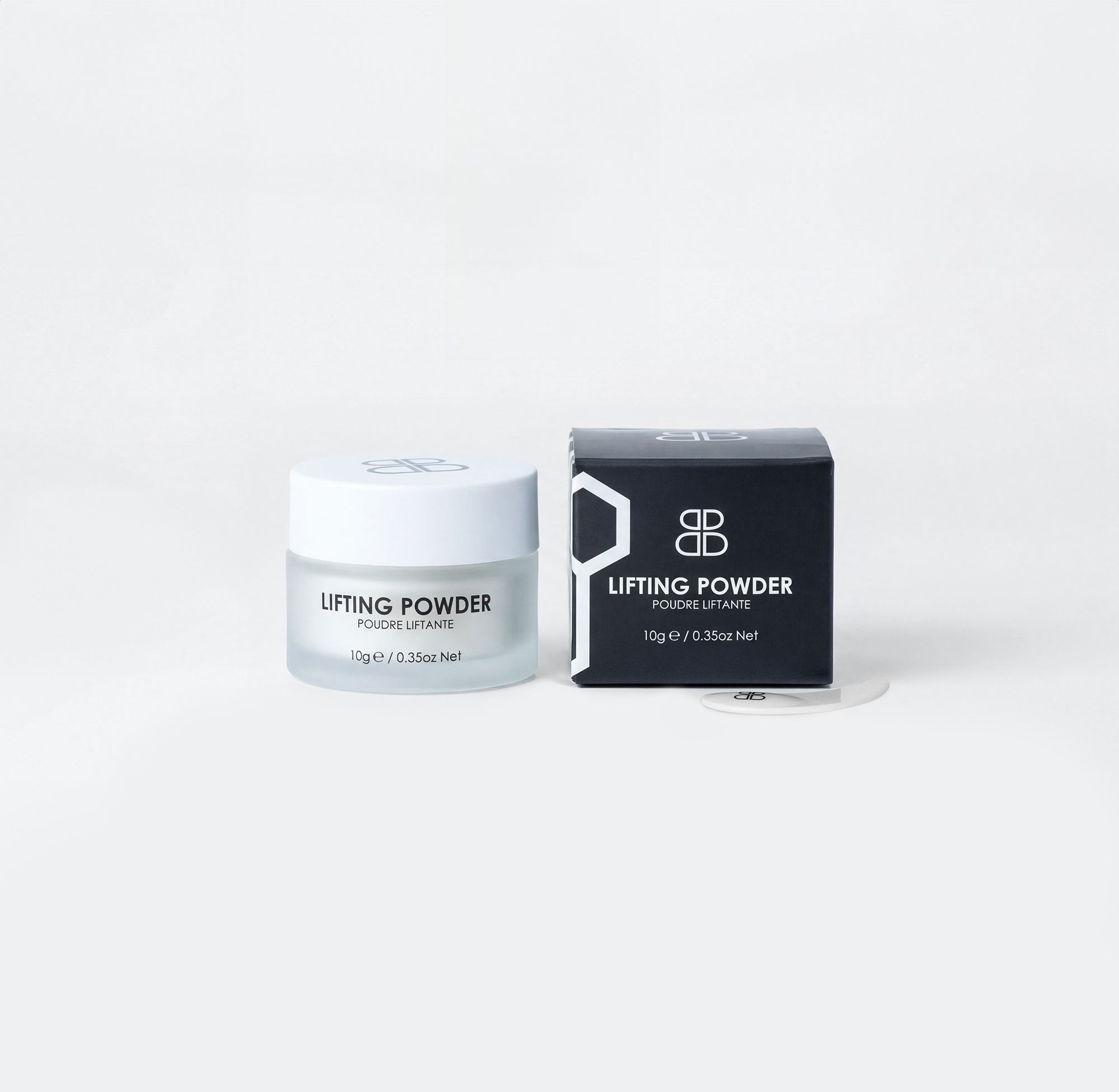
Lifting Powder
Mixed into each step to thicken the formula for control on the flat shield. More powder slows the process, so it shifts the timings longer.
Shop Lifting PowderTint Timing After a Lift
If a tint is added, it sits in the process after neutralising and processes far faster than it would on its own. The lift opens the cuticle, so colour penetrates quickly and deeply — which means tint times are reduced, not standard. As a guide, allow around three minutes for fine lashes, three to four for normal, and up to five for thick. Watch the colour develop rather than relying on the clock alone. Pairing a lift with a tint is covered in lash lift and tint.
| Lash type | Tint time |
|---|---|
| Fine lashes | 3 min |
| Normal lashes | 3–4 min |
| Thick lashes | 5 min |
A Word on Cling Film
Cling film is sometimes used over the lashes during Step 1 because it traps body heat and acts as a catalyst, speeding the process up. The trade-off is control: it makes the lashes harder to check and raises the risk of over-processing. If it is used at all, it should be used with caution and the lashes checked carefully, because a faster process is only an advantage if you can still stop it at the right moment.
The Underlying Principle
Anything that speeds processing — a warm room, cling film, a stronger formula — shortens the window in which you can read the lash. The slower, more controllable the process, the easier it is to stop at a fully processed, healthy lash.
Frequently Asked Questions
How long does a lash lift take to process?
Why do my processing times keep changing?
How do I know when the lashes are processed?
What happens if I over-process or under-process?
Are tint timings the same as normal?
Does powder change the timing?